This story was a class project focused on enterprise stories. I decided to write about this topic after participating in a UW stadium cleanup event and thinking that more people should know about the aftermath of a beloved school event. During the process of creating this article, I conducted interviews, wrote, researched, and took photographs
Behind the Scenes of Cleaning Husky Stadium
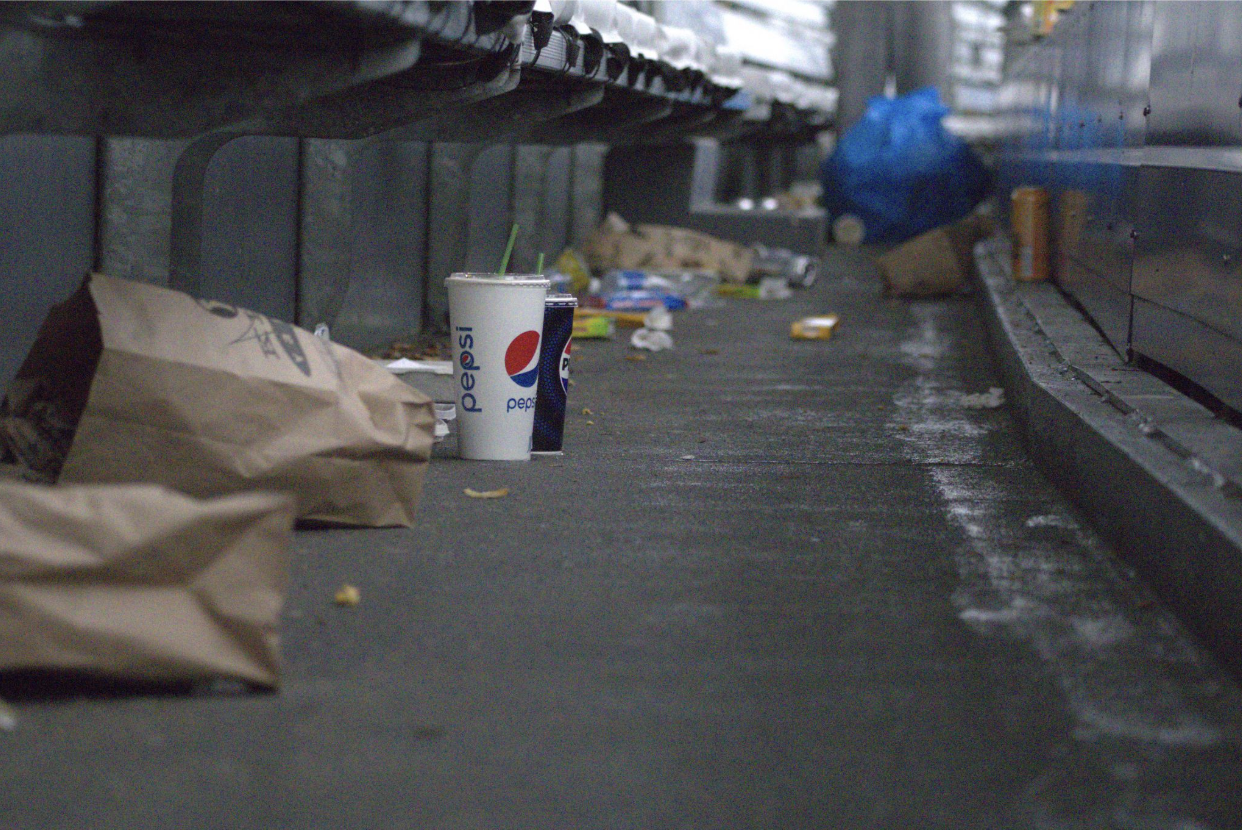
A row of Husky Stadium after a home football game, showcasing the waste that is left behind. Volunteers will sort everything into bags for hauling away. (Photo by Faith Ellis)
While in the stands of a sporting event, rooting for your school or local team, most people are probably not thinking about the mess that gets left behind.
Mountains of food, wrappers, and beer cans are left after every University of Washington home football game, but someone has to clean them up.
After every home game, UW students and community members volunteer to pick up waste left by the event, ensuring the area is clean again for the next game.
One group that is a consistent presence at the stadium cleanups is the Compass and Charts Society, which sends 25 to 30 students to four football cleanups a year, as well as to other volunteer events.
Their group president, Jarelene Vasquez, explained the volunteer process.
As an organization, they volunteer through UW Athletics, where they signed a contract to volunteer four times with a minimum of 25 people per session. If they send 25 or more, the group earns $15 per person per hour of cleanup. With Vasquez's estimate of three to four hours, that translates to $1,125 to $1,500 if they bring the minimum number of people each time they volunteer.
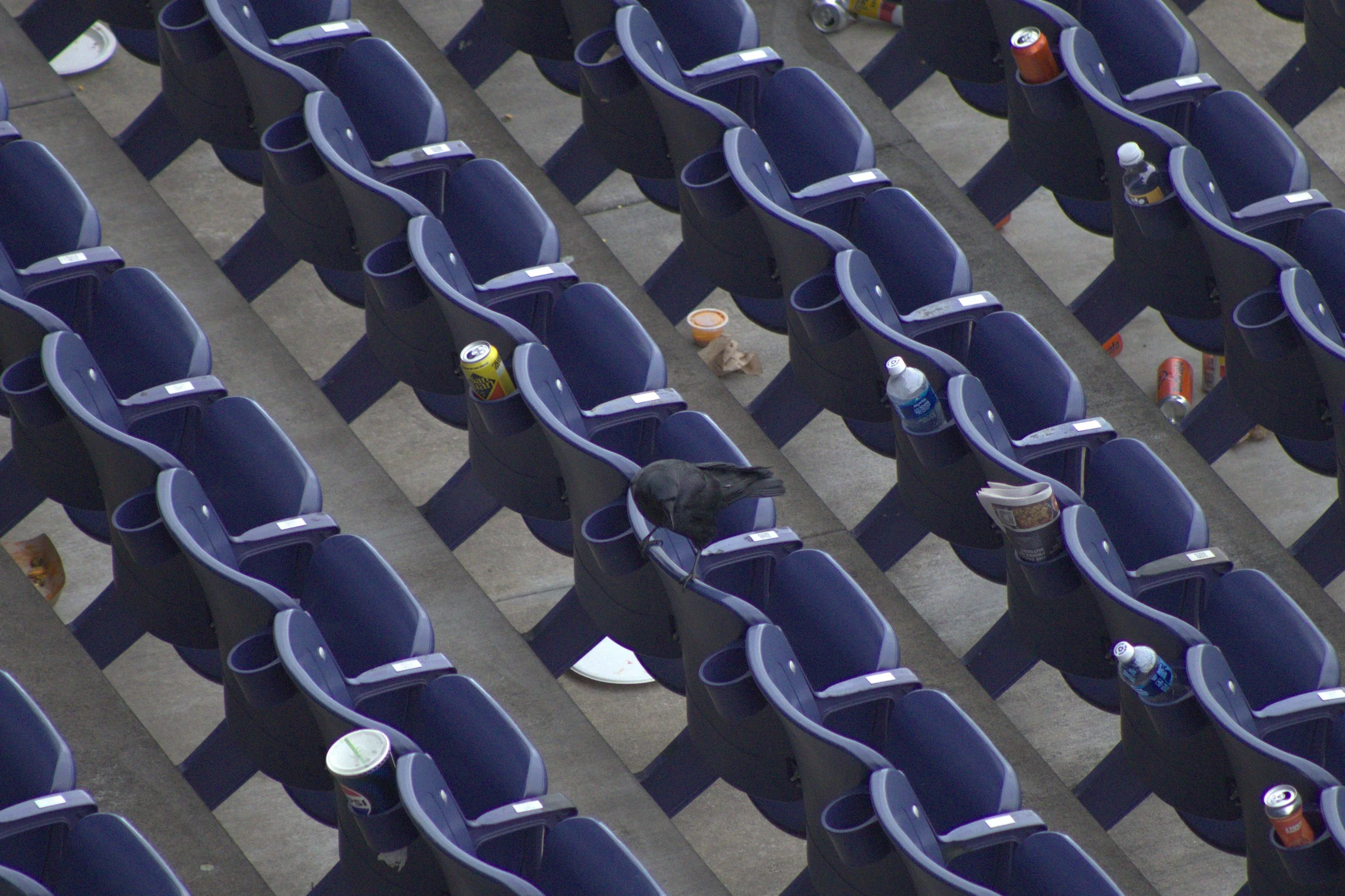
A crow perched among the trash left behind, looking for a meal. After every game, a swarm of crows and seagulls comes to the stadium and eats food that was left behind. (Photo by Faith Ellis)
The aftermath of the Ohio State game was five hours of sorting through beer-soaked garbage, pom-poms and spilled food, separating everything into compost, recycling and trash. By the end, everyone was sticky from the numerous cans of alcohol that had to be poured out, and a massive amount of bags were left for the staff to compact and dispose of.
Tyler Haggett, a member of the stadium staff who has been working for 16 years at the UW, said that after each cleanup, the bags are sent to the UW Recycling facility. There, the diversion rate of what is kept out of the landfill is counted, and the results are returned to the stadium staff.
According to UW Sustainability, in 2018, 75% of all waste from Husky Stadium was diverted from landfills.
Post-pandemic, with tightening regulations, that number has dwindled to 33.5% in 2024.
UW Sustainability had a goal for the 2025 season to return waste diversion to its peak level. While data for the current season is unavailable, Haggett confirmed that they are already seeing improvements.
“The biggest challenge is getting concessions and other trash-generating things to get to compostable items.”
With each game producing around 180 cubic yards of trash, if UW Sustainability were able to work with vendors to transition to more compostable items and achieve a 75% waste diversion rate, then 135 cubic yards of waste would not end up in a landfill after every home game.
While the university does not conduct any additional sorting, groups like Compass and Charts volunteer their time to come in and clean, which is what keeps the waste diversion program going.
Throwing trash on the ground at a stadium, like littering in general, is often caused by a lack of nearby trash cans, laziness or the belief that someone else will pick it up.
A study conducted by Pennsylvania State University in 1973 found that giving different types of reinforcement for cleaning up after yourself and a small bag to put the trash in resulted in a significant decrease in the amount of trash left behind.
It was found that adding some form of reinforcement, positive or negative, resulted in a 45% decrease in trash left behind in those sections.
Logan Harris, a regular volunteer, said groups are asked to meet by 7:30 a.m. at Husky Stadium and break into smaller groups of three. One person in the group will pick up recyclables, another will pick up compost and finally, what is left behind is picked up by the person assigned to trash.
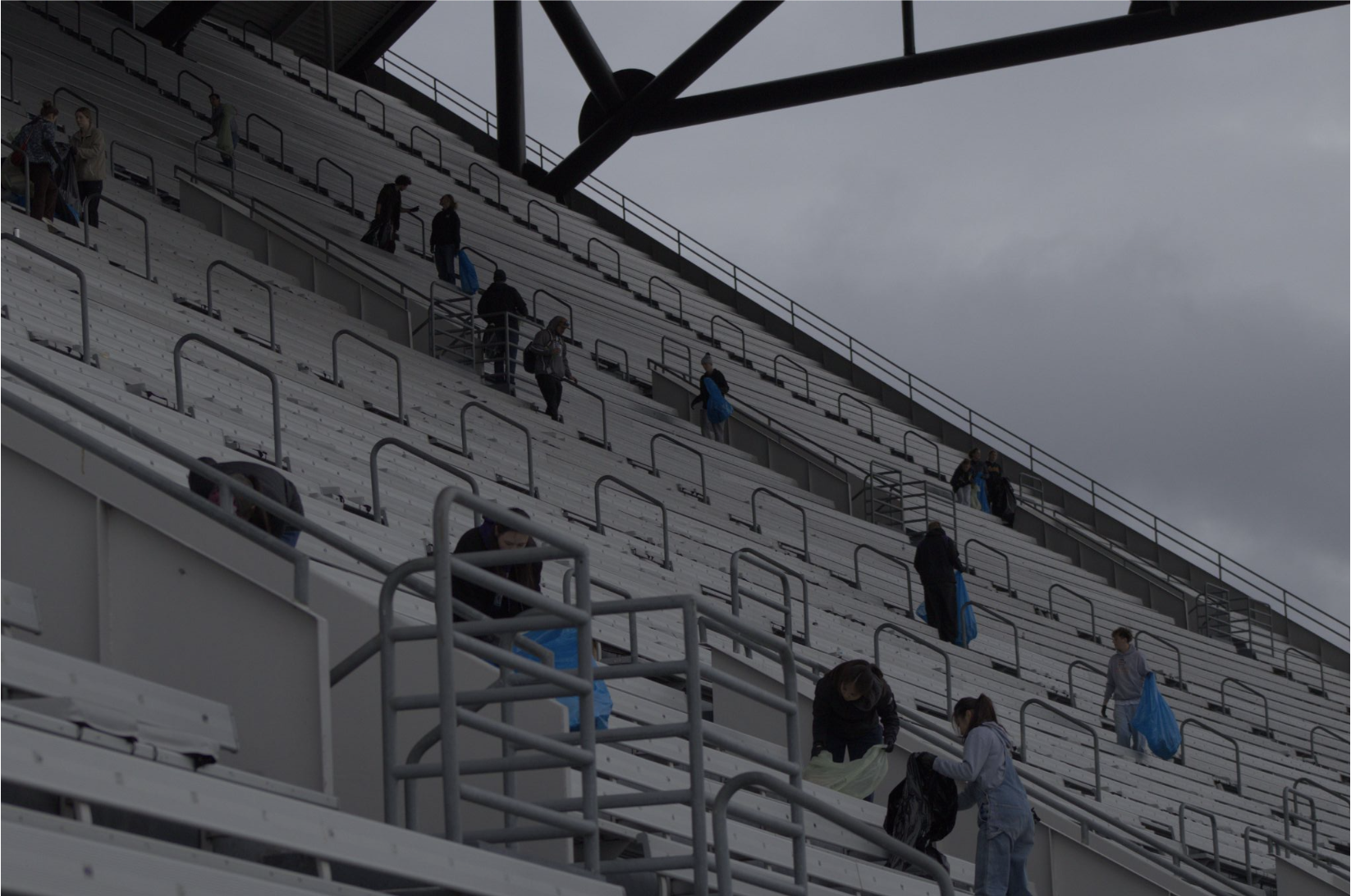
The volunteers of Husky Stadium picking up trash the day after a football game. They pick up everything they can and will likely end up dirty with discarded food and alcohol. (Photo by Faith Ellis)
Harris agreed that cleaning up typically takes four hours, sometimes longer, and that some messes cannot be finished before the stadium staff has to ask them to leave. He said the worst of it is that after it rains, any paper material falls apart, but still needs to be picked up.
Harris described an instance in which he was on recycling duty during a cleanup. He recalled pouring out can after can of leftover alcohol to the point where the liquid soaked through his shoes and socks.
There is one small thing that he wants people attending the games to know about the cleanups.
“You could, on your way out, just toss it in a trash can, makes our job a little easier. We don’t have to spend as much time there on a Saturday or Sunday morning, we can go do homework or rest a little sooner.”